MIDI files are pretty amazing things; they take up a fraction of space (a matter of kilobytes) and feature all of the notes, instruments and drums of a piece of music; played back exactly as they were composed! If you’re looking for something to play your musical files then the Bundled Midi HW player could be just the thing you need.
Choose to play back MIDI files individually or as a playlist – play your favorite video game themes together in one convenient place! The unit has four buttons and is very easy to use, with navigational controls for up, down, enter, and back; moving around the dinky display screen. The HW Player supports most modern MicroSD cards with storage capacities up to 64GB, which might just be enough for every MIDI file ever made!
Each file has an 80 characters limit which can be displayed on 6 selection lines. It’s designed for the DiscKlavier Yamaha Piano and other MIDI Instruments, and comes with a 3D printed case. At the lower end of the device you’ll find a 5-Pin MIDI socket for connecting to your synths and sound modules!
Google MIDI files (other search engines are available) to see the wealth of music on offer. Many ringtones also used this format for pop music synergy in the early 2000s, so you’ll definitely find something you like. It’s the first product from Frett 27, and we’d love to see more!
Remoticon is a fully virtual hardware conference with 20+ workshops, 2 keynote talks, and 8 different demos. Join the weekend fun from wherever you are. Remoticon will have instructors teaching workshops from all across the globe, from Australia to India, from North America to the Netherlands.
Meeting virtually provides the perfect platform for more space, more people, and more options. Attend demos about Design Methodology, Robots, Zero to ASIC, Edge-Based Voice AI, and other awesome topics. Join workshops covering topics such as Reverse Engineering, Tiny ML, How to Hack a Car, Glowy Origami, and so many more.
In need of some creative inspiration and socialization with fellow hackers? Come hang out Friday night for a community Bring-A-Hack! There’s even a virtual Hackaday SMD Challenge for those who want to learn and those who want to put their skills to the test.
You’ll never guess the best part. I’m sure you’re thinking, “how could this get any better?” Remoticon Main Track tickets are free! You can also donate with a pay-as-you-wish ticket. Donations will go to charities that feed, house, or educate people.
Attendees only pay $10 to join a workshop. Some workshops do require hardware, which may include things you already have sitting on your workbench.
So the real question is what workshops and demos are you going to pack into your schedule the weekend of November 6-8th? We can’t wait to see you all there!
Bit crushing is a unique digital effect which, essentially, reduces the fidelity of the sound – the best way to imagine it is that it reduces the resolution of the audio, much like pixelation in digital images. The 8BitM8 is a hardware bitcrusher which comes hand painted and is packed with high quality components, the most notable of which is the super arcade button!
The 8BitM8 was inspired by the tonal qualities of vintage samplers, MPCs and lo-fi effects. It’s able to output 4, 6 and 8-Bit audio with controls for mix, sample rate and a built in lowpass filter. The arcade button has a momentary mode, for quick chopped-up glitches, or a latching mode for more sustained, conventional on/off operation.
For fans of the Casio SK-1, SP12000 and range of early Akai 3000 series samplers, the 8BitM8 allows you to create a lo-fi sound, with sounds spanning subtle overtones to extreme digital distortion. Choose from a range of colour combinations and button types – the 8BitM8 also features true bypass, and is powered by a 9V centre-negative adapter (not included).
The 8BitM8 is available in midierror’s store, alongside a few other hand-made musical gadgets. Check out the demo video below to see it in action!
Many synthesizers come with built-in arpeggiators, but for those that don’t the ARPIE is just what you need. It comes in a pocket sized package, and runs off a battery or a power supply – and is absolutely packed with features for undulating melodic arpeggios! With a customer base including Jean-Michel Jarre and Vince Clarke, you can be sure the ARPIE is a potent creative force in any electronic studio.
The ARPIE is designed by Jason Hotchkiss, and is so feature rich it has a 40 page manual! You’ll find controls for transposing, pattern, rate, span, velocity, length and various sync modes for external gear. It features both a MIDI in socket, and a MIDI clock in so you can have one source controlling the tempo, and another controlling the arps!
This is the ideal addition to any synth which doesn’t have an Arpeggiator – that includes the mighty DX7, and many of the early FM Synths. Even if your synth does have an arpeggiator, chances are this one has way more options and features!
This ARPIE is sold by midierror, and comes fully constructed and tested. If you prefer a kit version, you will find them here. See what it can do below:
Programming your own musical interfaces is getting more and more accessible, with the advent of the Arduino, Raspberry Pi, and Teensy boards to create your own musical hardware. This MIDI Breakbout Board is an attachment for the Teensy which puts 10 MIDI sockets at your disposal, with MIDI in and out to communicate to your synths, effects units, and drum machines.
The Teensy does a great job as a high fidelity audio processor as well as being perfect for sending and receiving data. This addition to the board connects real-world MIDI devices to the Teensy, allowing for MIDI merging, splitting, filtering or sequencing – depending on what you want to make. You can trigger synths with a sequence of MIDI notes, control the speed of Drum Machines via MIDI Clock, or send Control Changes to any outboard device!
This breakout board is compatible with Teensy 4 and is powered from the Teensy itself. It comes as a PCB alone for total construction (see the attached BOM), a kit of full parts, and there’s an add-on option with acrylic panels as an enclosure.
The Teensy MIDI Breakout Board is sold by Deft Audio who are based in the USA. Other boards are available for earlier Teensy models from their shop!
Southern California is not known for its harsh winters. In fact, it’s probably safe to head out in flip flops and a hoodie on any given day all winter long. With that assumption in mind, that’s exactly what I was wearing when I headed south to Orange County for my very first Sparklecon. The weather would soon show my folly, but it wouldn’t dampen the fun awaiting me.
If you’re not familiar with Sparklecon, it’s an annual gathering of hackers, artists, tech aficionados, and everyone in between, for a weekend of talks, demonstrations, workshops, games, and socializing. It’s organized by 23b Shop, a makerspace in Fullerton, and its neighbors, the National Upcycled Computing Collective (NUCC), and the Plasmatorium. With doors wide open at all three shops, musicians and deejays performing, and tents, couches, and a fire pit occupying the road between them, Sparklecon felt like the best nerding-out block-party I’ve ever been to.
Day One: Rain, Wind, and Fire
We don’t get much rain here in Southern California, but the week leading up to Sparklecon was decidedly wet. The weekend, and Sparklecon itself, were no exception.
It didn’t take long for attendees to re-dub the event “Sprinklecon.” Nonetheless, many of the outdoor activities, like car hacking with Will Caruana, went full steam ahead.
Saturday also included tips on how to get unruly 3D printers to behave, a discussion on different ways to publish research, and a workshop on social engineering from an information security perspective.
Meanwhile, an open table that the NUCC folks had named Kevin spontaneously emerged as a hub of hardware hacking. Roger Cheng brought out his KISS Tindie band and supplies for others who wanted to try their hand at freeform wire sculpture. Beau Ambur busied himself building a pair of synth kits he brought back from Germany. And Jaren Havell tinkered on a tiny Tesla coil kit he had picked up after arriving in town.
By the time the evening rolled around, the worst of the rain had passed, and the outdoor party came to life. A game of hammer Jenga was as much fun for the players as it was for the spectators.
For those who were brave enough to climb out of bed in the early morning cold, Day 2 kicked off with breakfast at the Mexican joint down the block. After a relatively late night of partying to finish of day 1, I was not enough of an early riser to get there by 7:45. But I did arrive in time for a fireside chat with Barb on how she’s managed to be one of the most amazingly productive makers around. Her ongoing project, the Dodecahedrum, was a hit with the audience.
The hardware hackers from the day before (myself included) reunited at the table they had claimed inside NUCC. This time, I was prepared, and brought my own stuff to hack on. Jaren took a quick interest in my CRT projects, and it wasn’t long until we had The Matrix running on my little green screen.
Sparklecon was an absolute blast. It was a wonderful opportunity to meet a diverse set of people with an even more diverse set of interests and skills, and it was flat-out fun from beginning to end. I didn’t make it out to last year’s event and now I know I wish I had . Rest assured I’ll be there for Sparklecon next year, rain or shine.
For other perspectives on the weekend, be sure to check out the recap video by Barb:
You can also get a deeper look from Roger Cheng’s blog posts for day one and day two of this excellent conference.
We are looking for technical and creative talks and workshops. The overarching theme is Hardware Creation, which is something that Tindie sellers know all about! I’ve already seen some sellers have gotten their propsals in and wanted to encourage you, if you haven’t decided yet, to go ahead and get that proposal in!
The Details
What: The most awesome hardware conference ever When:November 14-15, 2015 Where: DogPatch Studios 991 Tennessee St, San Francisco, CA 94107 Deadline:Oct. 10th
Travel stipends are available for accepted proposals.
I highly recommend Google Flights. It has many features to show if you there is a cheaper flight near your search. As an example, the search above shows there is a $75 cheaper option. $703 round trip across the Pacific!
But why Hong Kong? 2 reasons:
Save $500 – flights to Shenzhen were $500 more expensive
More people speak English
Once you land in Hong Kong, you’ll just catch a bus or van to one of the crossings into China. Super easy, and I’ll cover that in the next post in this series.
Time to get a VISA
If you live in the US, you’ll have to get a Visa to visit China. You do not need one to go to Hong Kong. There are services that will get this for you, but with a consulate near by, I just went up to San Francisco.
Paperwork
Here is the link to the China Consulate in SF’s paperwork page. Depending upon your situation, you will need different forms. The Visa Application Form must be printed with information typed out (leave intended number of entries blank).
Recently the US & China agreed upon 10 year visas – and that is what you want! Once your number is called, I just told the person I would be going frequently, and she gave me a 10 year – so hopefully this will work for you too.
Bring to the consulate:
Printed Visa Form
Your Passport (you will leave this at the Consulate while it is being processed)
Flight information printed
Letter from a company or your hotel reservation
Passport Photos – I just got mine taken at a CVS
The process:
Get up early, arrive an hour before it opens, and get in line.
Once in, you’ll walk through a metal detector, get a number, and wait.
Because my trip was in a few days, I had to have mine rushed for the next day. It cost $160 and I got it back the next morning.
Dealing with a Cell Phone in Hong Kong & China
I thought I would be clever, get a T-Mobile SIM card, and have unlimited data in China & Hong Kong – wrong. T-Mobile said I would had to have had an account for months for that to work, and I did not have months. If you are on T-Mobile, sweet! otherwise its time to get creative!
Have an old iPhone? Unlock it!
Once T-Mobile dashed my plan, it was time to get a phone that I could put a Chinese SIM card in. Fortunately, I had an iPhone 5 that was off contract. If you use AT&T, here is the page to unlock your old iPhone. It took a few minutes for it to process.
With an old iPhone, I could install all of the apps I thought I would need, and once in China, just throw a SIM card in and I’d be off and running. For this reason (and for setting up a VPN), I don’t recommend getting a phone in China and setting it up over there.
Give yourself some international data
Most likely you’ll want some data for when you land in Hong Kong. There is free Wifi in the Hong Kong Airport, but once you leave, you’ll still probably want a lifeline to the world. I just got a 120mb international plan from AT&T for $30.
Apps to install on both phones
Wechat – everyone uses Wechat for talking to friends, groups, businesses, you name it.
China’s internet is heavily filtered. You will not have access to Facebook, Twitter, Google, Youtube, and many other websites without a VPN.
I just used the $13 ExpressVPN Plan on my computer & iPhone. Install while you are still in the US!
ATMs in China
I bank with Schwab so I looked for banks in the Plus Network. China Merchants is in the network, so that is who I grabbed money from. You’ll want to check with your bank.
Also, VISA has an ATM locator that can show you where ATMs are.
Metro Maps
I like to have the metro maps saved in my phones just in case
Hong Kong Metro
Shenzhen Metro
Final necessities
Depending where you are, you may not have access to toilet paper, so bring some. Normal toilets in China are holes in the floor (you can Google this if you really want), that may or may not have toilet paper. That is why you should bring your own. In the newly constructed buildings like malls, there are western toilets.
If you have medical needs, you’ll want to bring some extra medicine just in case.
What’s next?
Next in the series will be the things to do once you land. Where are the vans to the border crossings? Which crossing should you take? Where can I get a SIM card in Shenzhen? We’ll cover all of these questions and more, so stay tuned! We’ll see you in Hong Kong!
Shenzhen! It seems like every day I hear another person tell me they are going or planning on visiting. Having just returned, here are 26 things to know before you go:
You don’t have to speak Mandarin
Before my trip, the most daunting thing to me was the language barrier. I don’t speak Mandarin, and fortunately you don’t have to. At restaurants, many of the menus (but definitely not all) will have photos so you can just point. Many of the people in the markets will speak enough English to barter and sell. Basically in the city center, you can survive with English. Most signs are in English & Mandarin.
If you plan on going to factories or outside the city center, you will need a translator
One tip I was told, “factory managers have been working with westerners for 30 years, you won’t need a translator.” Well that turned out to be totally false. I went to 3 factories, and out of the hundreds of people I saw, as far as I can tell, only 1 person spoke English. My driver didn’t speak English either so it was an interesting adventure.
The city is built on manufacturing
As real estate prices go up, the factories have moved further and further from the center of town.
The city is incredibly modern
Outside of the city is much less modern
A contrast of new wealth and traditional Chinese culture
The subway is incredible
The subway is one of the best in the world – if not the best- I’ve ever been on. Clean, no crime, and not a sign of graffiti in sight. Note: you will have to put your bag though an X-ray each time you go through for security. However, for the safety, its amazing.
It is safe
Yes, you can buy knock-offs
The electronics markets at Huaqiangbei are MUCH bigger than you think
However that isn’t the full story – there is original hardware being produced by Chinese companies
There are startups in apartments just like in Silicon Valley
There are also companies that have raised millions of USD from venture capitalists
And then there are the huge tech companies, such as DJI’s 11 story office
The food is amazing and cheap
Even the Western food is better (but the same price you pay in the US)
Your dishes at restaurants may come wrapped in plastic
Western toilets are in the malls
Everyone chats on WeChat
Hong Kong is a ~1hr train ride away
Yes you can get tailored clothes for cheap at Luohu (much cheaper than Hong Kong)
With access to cheap clothes, people truly express themselves
There is a vibrant art scene at OCT
Traffic laws seem to be a suggestion, so make sure to be on the lookout for motorbikes on the sidewalk
If you get a China Unicom SIM card, this is only a welcome message – your phone hasn’t been hacked (phew!)
Google, Facebook, and Twitter are blocked, so you will need a VPN to access them
What’s next?
Next in the series will be the things to do before your trip. Issues we will cover –
How to fill out your Visa form
How to set up your cell phone situation before you leave
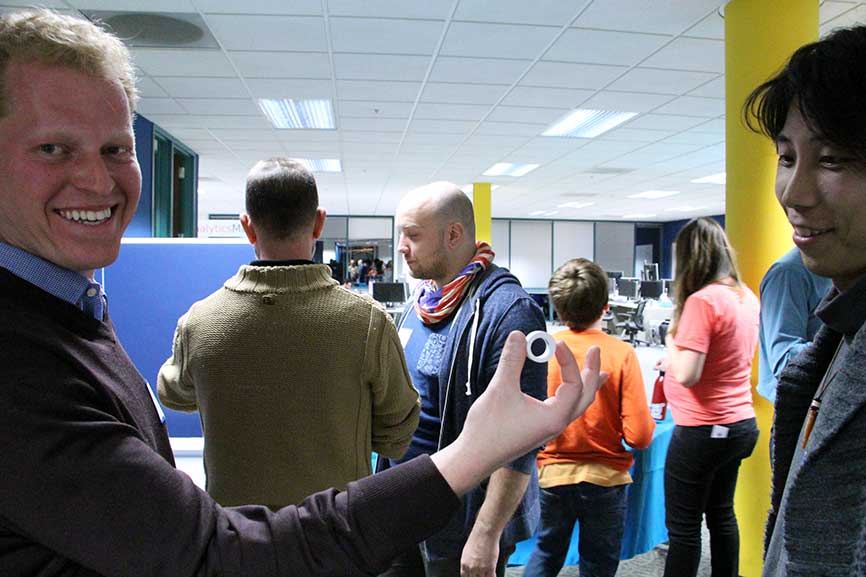
In January, we started the Silicon Valley Hardware Meetup group here at Tindie HQ, with the goal for people from all around the South bay and Peninsula to meet other hardware enthusiasts like them as well as show off and discuss projects they are working on. We provide pizza and drinks and about halfway through the evening, there are 2-minute demos where attendees can give a “show and tell” about the project they are working on or featuring on Tindie, resources they are looking for, or introduce an idea they are working on. We have these meetups on the last Thursday of each month and February was another success!
We had even more 2-minute demos this time! Below are some quick recaps on what we saw:
Nick brought two of his projects: the J1772 Hydra and OpenEVSE II. The Hydra is a dual-head electric vehicle charging station/splitter, available in splitter or standalone EVSE. The variants can either be put into a 208/240 volt electric circuit or a J1772 inlet to share an existing charging station with two vehicles. The OpenEVSE II boards easily assemble with a J1772 connector, cable, and other components to create your own charging station.
Philip is working on an upcoming project called OSHChip. It is a very small processor board with built-in Bluetooth radio and is packaged like a 16 pin DIP. He is also looking for someone to help out making a great website for this project, so click his name to get in touch!
Daniel brought a few projects he has available through Tindie, including the ArduRF family of boards. These are Arduino compatible boards that come in three sizes, each optimized for a different application environment. All have integrated wireless capabilities and LiPo battery circuits.
Nathan brought in the Bolt M1, a 100% electric bike that has a 50 mile range, goes up to 35 miles per hour, and connects to a smartphone to start, which makes it keyless. The entire system is powered by a microcontroller and a lithium battery to get around urban traffic and go green.
Vince demonstrated his Precious Metal Validator, an innovative hardware and software system for testing precious metal bars and coins for authenticity using ultrasonic pulses.
Mike brought in the Kinoma Create, a Javascript-based prototyping platform that is wi-fi and bluetooth enabled. This device helps prototype electronics and has a touchscreen, I/O for sensors, and 66 hardware pins.
Christoph and Jelena gave a demo of the Nixie, a wearable, flyable quadcopter. With a simple gesture, the Nixie can fly, take high definition images and 1080p video, and return to you. They are also hiring designers and engineers. Click on their name to see what positions they are looking to fill for their team!
Greyson Jennings: Slash Screen
Greyson is working on his first smartphone app. With Slash Screen, you will be able to use your camera to capture colors from everyday items and save them to your Adobe Kuler account!
Graham demonstrated the new Pebble Time smart watch, currently featured on Kickstarter. By using the data pins on the back or bluetooth, it is easy for Pebble Time to interface with your projects and give you a new platform to work on.
Shingo showed off Ring, a wearable ring that pairs with IOS or Android to detect the smallest finger movements and, with customizable gestures, take action. The battery lasts 1-3 days and you can do things like adjust volume on your phone, skip a song, turn on lights, and even exchange contact information.
Aaron returned this month with an update about his miniature Macintosh computer: he now has a blog with more detailed photos and build log. The project is based on a Raspberry Pi compatible board running Linux and an emulator with Mac OS 7.5 that he mainly uses for playing Oregon Trail and watching After Dark screensavers.
Iru spoke about her new company, Yours, that has created a new social, mobile app that helps others anonymously seek or give advice, express their feelings, and meet others. She is currently looking to expand her team, so get in touch with her for more details!
Sridhar is working on an IoT startup focused on air quality. He is currently looking to expand his engineering team. If you are interested, get in contact with him by clicking on his name above!
Surya has a software and hardware platform start up that’s focused on active safety applications for automotive. He is currently looking for an experienced embedded systems engineer to join as a co-founder with a strong background in safety-critical software, hypervisors, DSP, and signal processing.
MAMORIO, “the world’s smallest bluetooth beacon” is in production now. It’s waterproof, small enough to fit in your wallet, attach to a keyring, or even a pet collar. It will send alerts straight to your phone and has an option for “crowd-tracking” which allows others nearby to help find your misplaced item as well.
We will not have an event in March here at Tindie HQ, but for anyone in the Shenzhen China area, shoot us a note if you are interested in attending a meetup there! Keep an eye on our meetup page for details of the April meetup as well as an upcoming local factory tour. More photos from the evening are below!
Cookies help us deliver our services. By using our services, you agree to our use of cookies. Learn More.
The cookie settings on this website are set to "allow cookies" to give you the best browsing experience possible. If you continue to use this website without changing your cookie settings or you click "Accept" below then you are consenting to this.